
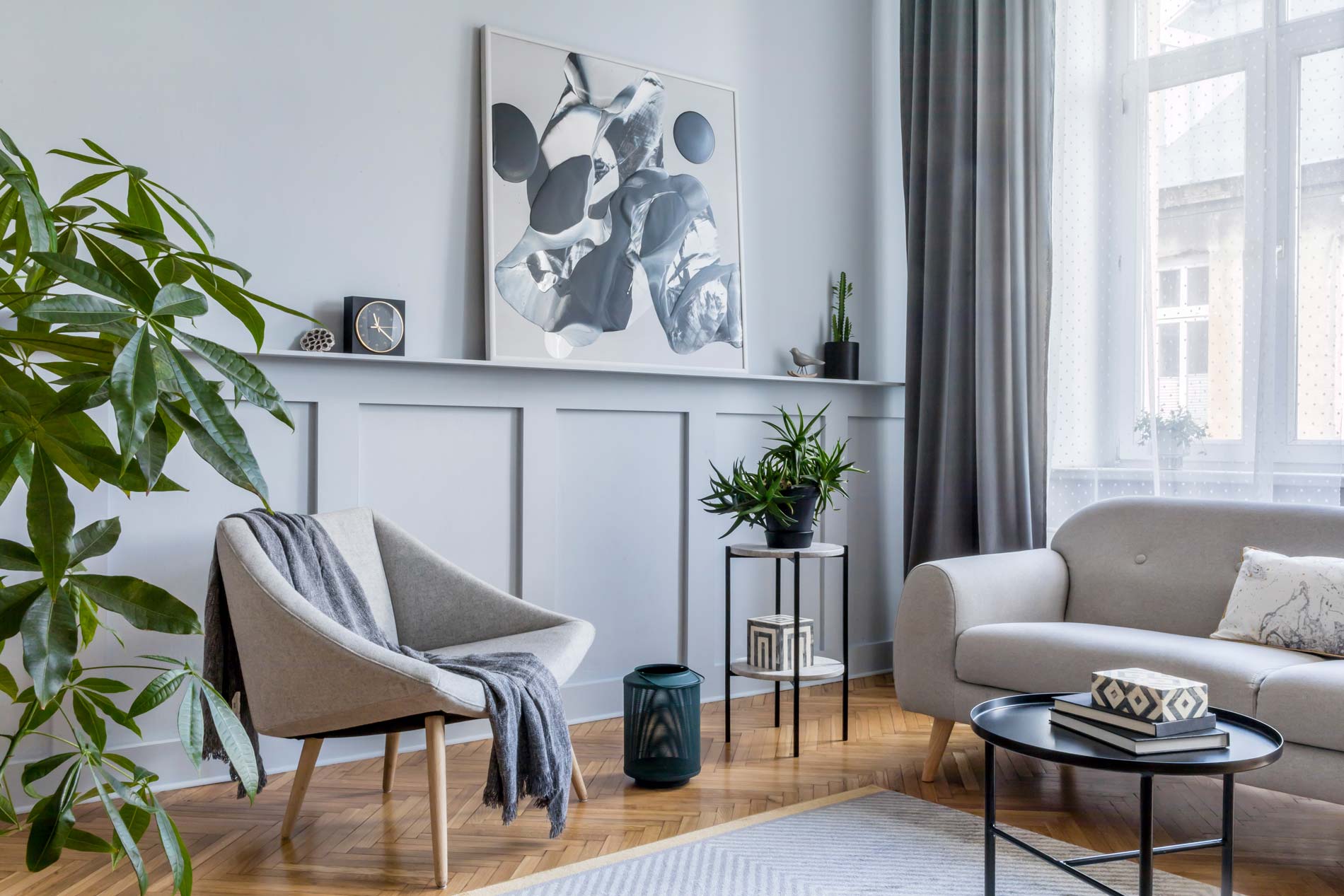
AI can generate a polished living room in seconds. It can suggest a color palette, arrange furniture, and create an image that looks ready for a magazine. But for a family in Fayetteville, NC, a beautiful room is not automatically a meaningful one.
Your living room carries evidence of how you live, who gathers there, what you have collected, and what you want your home to feel like. Those details are difficult to reduce to a prompt.
Quick answer: An AI-generated living room can provide visual inspiration, but it cannot fully understand your family history, routines, sentimental belongings, architectural surroundings, or the way you want to feel inside your home. Thoughtful interior design brings those pieces together so your living room reflects the people who actually live there, rather than simply reproducing a popular aesthetic.
What Fayetteville homeowners should know
-
AI images are useful for exploring ideas, but they often prioritize visual impact over the practical realities of everyday family life.
-
Homes around Haymount, Downtown Fayetteville, and newer parts of Cumberland County can have very different architectural details, proportions, and design needs.
-
Furniture inherited from family, artwork collected during military moves, children’s belongings, and meaningful objects often deserve a place in the design instead of being edited out.
-
A room that photographs beautifully is not necessarily a room that supports conversation, entertaining, pets, children, storage, or the way your household relaxes.
-
The strongest living rooms combine beauty, function, architecture, and personal history rather than following one design trend.
Why Can’t AI Tell Your Family’s Story Through Interior Design?
AI cannot tell your family’s story because it understands patterns and visual prompts, not the personal meaning behind the objects, routines, memories, and relationships that make a Fayetteville home distinctive. It can imitate a style, but it cannot independently know why a particular chair, painting, photograph, or gathering space matters to you.
Ask an image generator for a “warm traditional living room,” and it can produce one.
Ask it to understand that a chest belonged to your grandmother, that your family gathers around the coffee table every Friday night, or that a collection from years of military assignments deserves to remain visible, and the problem becomes more complicated.
Those details are not clutter to design around. They are part of the design.
At Anne Monje Designs, we approach interiors by looking beyond what simply coordinates. We consider what belongs in the home, how people use the room, and how individual pieces can work together to create a space with character.
Why Does Personal Interior Design Matter in Fayetteville, NC?
Personal interior design matters in Fayetteville because local homes and local families represent an unusually broad mix of architectural histories, lifestyles, and experiences. A historic house near Haymount may call for a completely different design response than a newer home elsewhere in Cumberland County or a household shaped by years of military relocations.
The architectural differences are real. Fayetteville’s Haymount Historic District includes residential architecture dating from roughly 1817 through the mid-20th century and is recognized for its architectural significance.
That history creates opportunities that a generic AI rendering may overlook.
Original proportions, fireplaces, molding, windows, ceiling heights, and room layouts can influence everything from furniture scale to color selection. Newer homes may present different challenges, including large open spaces that need stronger visual definition or builder finishes that homeowners want to make more personal.
Then there is the human side of Fayetteville. Families connected to Fort Bragg may have lived in several states or countries before settling here. Others have deep roots in Cumberland County, Hope Mills, Eastover, or established city neighborhoods. A home might contain pieces from several chapters of a family’s life.
Good interior design finds a way to let those chapters coexist.
What Does an Interior Designer Notice That AI Often Misses?
An interior designer notices how a room feels and functions in real life, including scale, circulation, natural light, architecture, existing belongings, and the habits of the people using the space. Those physical and emotional factors are difficult to judge from an AI-generated image alone.
Consider a living room with an attractive arrangement on a screen. The sofa might appear perfectly proportioned because the generated room itself has no fixed dimensions. A pair of oversized chairs may look wonderful until they block the pathway to the kitchen. A pale rug may complete the image but make little sense for a family with young children or pets.
A designer can also ask questions an image generator does not know to ask.
Which seat does someone choose every evening?
Do ten people gather here during holidays?
Does the room need to feel formal for entertaining but comfortable on ordinary weekends?
Which pieces absolutely need to stay?
What do you want guests to understand about your home when they walk in?
Those answers begin creating a room that belongs specifically to your family.
What Are the Signs Your Living Room Looks Styled but Does Not Feel Like You?
A living room may be beautifully styled but still feel disconnected from your family when it resembles an inspiration image more closely than it reflects your preferences, belongings, and daily routines. Fayetteville homeowners often notice the problem not because a room looks bad, but because something about it never feels settled.
Common warning signs include:
-
You like the room in photographs more than you enjoy spending time in it.
-
Almost every decorative item was purchased at the same time to match a specific trend.
-
Meaningful family pieces are stored away because they do not fit the chosen aesthetic.
-
Furniture placement looks attractive but makes conversation or movement uncomfortable.
-
The room could belong to almost anyone because little about it reflects your family.
-
You repeatedly replace accessories because the space never quite feels finished.
-
A favorite heirloom, artwork collection, or piece from your travels feels awkward rather than integrated.
The solution is not necessarily buying more.
Sometimes the room needs better editing, more thoughtful placement, or a clearer relationship between old pieces and new ones.
How Can Family Heirlooms Work in a Modern Living Room?
Family heirlooms can work beautifully in a modern living room when they are treated as intentional focal points instead of objects that must perfectly match everything around them. The goal is usually not to make an older piece disappear, but to create enough visual connection that it feels purposeful within the room.
An inherited wood chest, for example, does not require every other piece of furniture to be traditional.
A vintage chair may work beside a contemporary sofa when proportions, fabric, color, and surrounding elements create balance. Older artwork can become more striking against a thoughtfully selected wall color. A collection brought home from different places can feel cohesive when displayed with restraint.
This approach can be especially appropriate in an area with an established architectural history. Haymount, for example, contains residences representing multiple periods of Fayetteville’s residential development rather than one single architectural moment.
A layered interior can feel equally natural.
When Should You Work With an Interior Designer Instead of Relying on AI?
Working with an interior designer becomes especially valuable when your project involves real dimensions, important existing pieces, competing household needs, substantial purchases, or uncertainty about how individual decisions will work together. AI can help you discover what catches your eye, while professional design can translate that inspiration into a livable Fayetteville home.
You might use AI to explore whether you respond to warmer woods, stronger color, traditional details, contemporary forms, or a particular combination.
That can be useful.
The difficulty begins when an inspirational image becomes a shopping list.
Real design requires decisions about furniture dimensions, fabric performance, lighting, room relationships, sight lines, architectural features, color undertones, and how purchases will coexist with what you already own.
For homeowners investing in several significant pieces at once, those decisions become increasingly connected. Solving them as a complete room can reduce the temptation to keep buying individual items in hopes that the next purchase will finally make everything work.
What Are the Most Common Mistakes With AI-Inspired Living Rooms?
The most common AI-inspired design mistakes happen when homeowners copy the appearance of a generated room without accounting for their own home’s dimensions, architecture, belongings, and lifestyle. In Fayetteville homes, those differences can be substantial, particularly between historic neighborhoods, established subdivisions, and newer residential development.
Mistake: Copying the entire image.
Consequence: Your room can feel like a reproduction rather than an expression of your family.
Better approach: Identify two or three characteristics you love, such as the palette, furniture shape, or mood, and interpret them for your space.
Mistake: Ignoring scale.
Consequence: Furniture that looked balanced digitally can overwhelm or underfill an actual room.
Better approach: Work from accurate room and furniture measurements.
Mistake: Removing everything personal.
Consequence: The room becomes visually coordinated but emotionally flat.
Better approach: Build the design around a carefully selected group of meaningful pieces.
Mistake: Chasing one trend.
Consequence: A room may feel dated as soon as the trend changes.
Better approach: Use trends selectively while giving permanent decisions a longer-term perspective.
What Does a More Personal Fayetteville Living Room Look Like?
A more personal Fayetteville living room looks like the people who live there rather than a perfect design category, combining appropriate furniture, meaningful belongings, architectural context, and practical choices into one cohesive space. It can still be polished and sophisticated without erasing the evidence of a family’s life.
Imagine a common local scenario.
A family has settled in Cumberland County after several moves. They own a sofa they want to replace, an antique table from a parent, artwork collected while living elsewhere, and photographs they want displayed without making the room feel overly busy.
An AI image might replace all of those pieces with coordinated new furnishings.
A personal design approach asks a different question: How can the new room make the pieces worth keeping look even better?
Perhaps the antique table becomes the anchor for a seating arrangement. Colors from collected artwork influence the textile palette. Frames are reconsidered so different pieces relate visually. New upholstered furniture adds comfort and consistency without making the room look as though everything arrived from the same showroom.
That is the difference between decorating around a style and designing around a life.
What Interior Design Solutions Help Create a More Meaningful Home?
Interior design services can help create a more meaningful home by connecting space planning, furniture, textiles, color, lighting, accessories, and personal belongings into a deliberate whole. Instead of solving each living room decision separately, Fayetteville homeowners can develop a clearer direction for how the entire space should look, function, and feel.
Depending on the project, that may include evaluating existing furnishings, identifying pieces worth keeping, planning furniture placement, selecting new furnishings, refining color relationships, and deciding how art and accessories should be displayed.
The result should not feel like a designer replaced your personality.
It should feel like your home became a clearer expression of it.
Should You Use AI Inspiration or Professional Interior Design?
AI inspiration and professional interior design serve different purposes: AI is useful for quickly exploring visual possibilities, while a designer can evaluate which ideas actually suit your home, belongings, budget, lifestyle, and long-term goals. For most meaningful projects, inspiration works best as a starting point rather than the final design plan.
AI is particularly useful for experimentation. You can test combinations you might never have considered.
Professional design becomes more valuable as decisions become more permanent, expensive, interconnected, or personal.
You do not have to reject new technology to value human design. The better distinction is knowing which job each tool is equipped to perform.
AI can help you see possibilities.
A thoughtful design process helps determine which possibilities belong in your home.
What Areas Does Anne Monje Designs Serve Around Fayetteville?
Anne Monje Designs works from Fayetteville, NC, where homeowners can find everything from historically significant residences to newer family homes requiring their own approach to interiors. The surrounding Cumberland County area includes communities such as Hope Mills and Eastover, while local landmarks and neighborhoods from Haymount to Downtown Fayetteville contribute to the region’s distinctive sense of place.
The City of Fayetteville recognizes both Haymount and Downtown historic areas for their architectural significance, reinforcing just how varied the local built environment can be.
That variety is one more reason thoughtful design should begin with the actual home instead of a generic image.
What Can You Lose by Designing Only for a Trend?
Designing only for a trend can leave you with a living room that looks current temporarily but lacks the personal layers that help a home remain meaningful over time. The biggest cost may not be choosing the “wrong” sofa or color. It may be replacing character with sameness.
Trends can absolutely have a place in a well-designed room.
The problem comes when every decision is based on what an algorithm currently recognizes as desirable.
Your family’s story already contains better material.
Furniture passed down through generations, art discovered somewhere memorable, books that are actually read, objects collected over time, and the needs of the people sharing your home give a room depth that cannot simply be generated.
FAQ
Can AI design my living room in Fayetteville, NC?
AI can help generate living room ideas, but it cannot fully design around your home’s exact conditions or your family’s priorities without substantial human input. Use it for inspiration, then evaluate dimensions, architecture, existing furniture, lighting, lifestyle needs, and meaningful possessions before turning an image into real purchasing decisions.
Is AI interior design useful if I already plan to hire a designer?
Yes, AI can be useful for communicating early preferences to a designer when you treat generated images as inspiration rather than instructions. Showing what attracts you can help begin conversations about color, mood, furniture shapes, or style. A designer can then determine which elements make sense for your actual Fayetteville home.
Do historic Fayetteville homes require a different interior design approach?
Historic homes often benefit from an interior design approach that responds to their existing architecture rather than attempting to make every room resemble new construction. Haymount includes residences spanning many periods of Fayetteville’s development, so proportions and architectural details may deserve consideration when selecting furnishings, finishes, artwork, and lighting.
Can I keep inherited furniture without making my home look dated?
Yes, inherited furniture can coexist with contemporary pieces when scale, color, material, and placement are handled intentionally. An older chest, table, chair, or artwork can provide exactly the individuality a newer Fayetteville living room needs. The goal is cohesion, not forcing every object in the room to come from the same period.
How can military families make a Fayetteville home feel more personal?
Military families can make a home feel more personal by intentionally displaying selected pieces that represent important people, places, assignments, and experiences rather than storing everything away. Near Fort Bragg, where relocation can be part of family life, a thoughtfully layered interior can help different chapters feel connected within one home.
Should everything in my living room match?
No, everything in your living room does not need to match for the room to feel cohesive. Repetition of color, shape, texture, material, or visual weight can connect pieces from different periods. In fact, carefully mixing old and new often creates more personality than buying an entire matching furniture collection.
How do I know which living room pieces are worth keeping?
Keep pieces that are meaningful, useful, well suited to the space, or capable of contributing to the new design with thoughtful placement or updating. Before replacing everything, Fayetteville homeowners can evaluate sentimental value, condition, scale, comfort, and adaptability. Sometimes one meaningful existing piece provides the starting point for the entire room.
What should I bring to an interior design consultation?
Bring anything that helps explain how you live and what you value, including inspiration images, room measurements if available, photographs, favorite colors, existing furniture information, and pieces you hope to keep. Equally useful is explaining what currently frustrates you about the room and what you want daily life there to feel like.
Create a Fayetteville Home That Feels Like Your Family
A beautiful living room does not have to look generated, perfectly matched, or untouched by real life. The most memorable homes contain layers, including architecture, family history, useful objects, beautiful pieces, and evidence of the people who live there.
At Anne Monje Designs, we can help turn those layers into a thoughtful, cohesive home that feels distinctly yours.